
Courses & Events
Energy, Materials, and Water Use in Semiconductor Manufacturing: Challenges and Opportunities for Supply Chain Resiliency
Thursday, Nov 5, 2026
04:30 pm - 05:50 pm
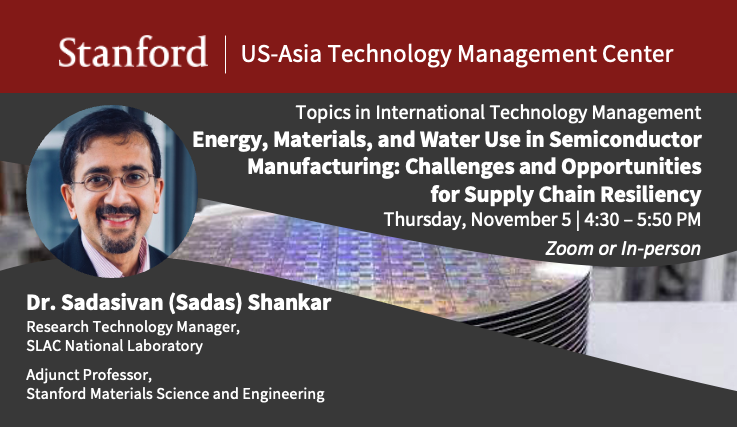
Semiconductors are essential to today’s digital economy, powering everything from everyday electronics to artificial intelligence. Yet their production depends on complex supply chains and significant amounts of critical materials, water, and energy.
Dr. Sadasivan (Sadas) Shankar, Research Technology Manager at SLAC National Laboratory and Adjunct Professor in Stanford Materials Science and Engineering, will share his research on how a circular approach to materials and resource use—including recycling, reuse, and localized processing—could reduce supply chain dependencies, improve resource efficiency, and create new economic and strategic opportunities for the United States.
Dr. Richard Dasher, Director of the US-ATMC, will moderate the session.
Abstract:
Students: Ava DeConcini (Summer 2024), Ulysse Marc Lemoine (Fall 2024-Spring 2025), Sharv Murgal (Nov 2024-Spring 2025)
Principal Investigators: Sadasivan Shankar, Robert Burgelman, George Cogan (Stanford University and SLAC National Laboratory
The intent of this project is to study materials and energy use in semiconductor technology, one of the most critical components of the modern economy that drives all aspects of electronics and computing from internet to automation and artificial intelligence. Our analysis attempts to cover the area in two phases: In the first phase (the current part of the research),the focus is on understanding the scientific and engineering analysis of materials and resources, while in the second phase the focus is on the strategic and business analysis based on the first phase analysis. The first phase research covered the following components: 1) Identify the key material and electronic components in semiconductor technology including critical materials as relevant to the semiconductor industry; 2) Quantify resource usage that includes materials, water, and electricity in processing and manufacturing; 3) Trace the supply chain of these materials and components needed in the industry. As the semiconductor supply chain is extremely complex, dynamic, interconnected, and quickly evolving, the research has attempted to qualify and quantify material and resource usage based on available data. In addition, the analysis also indicates that mining and extraction of materials is a multi-faceted problem with long term consequences based on policies, technologies, and business decisions. However, the analysis illustrates that the supply chain problem can be addressed by using a circular approach in which the materials and water can be recycled with efficient linkages between different aspects of manufacturing and consumer use. This is illustrated by comparing energy requirements for material recycling with that needed to mine and extract materials. For higher efficacy, it is important that the circular ecosystem be relatively proximate to the geographical area of manufacturing and/or customer use, depending on the ease of collection, transportation facilities, and technologies needed for further processing. The research also indicates that a rethinking of materials and resource processing will be of strategic importance to economies such as the US, where a renewed focus on efficient and intelligent reuse of materials across the different aspects of semiconductor manufacturing locally can mitgate the dependencies on external supply chains while catalyzing large parts of the economy with new innovations in technologies for materials collection and its processing. The analysis provides pointers to the possibility of a large economic boost to the local economies with optimized manufacturing at every processing step to newly designed supply chain landscape that can potentially be a significant part of the US economy even beyond the semiconductor industry. In addition, this may have implications to the security of the economies which are dependent on advanced computing and its ubiquitous applications.
The project was funded by the Stanford BGS fund and the DOE AMMTO EES2 funding of the SLAC National Laboratory.
Details
Registration:
Agenda:
- 4:30 pm – 5:50 pm Discussion and Audience Q&A
Venue:
- Stanford University, Bishop Auditorium, 518 Memorial Way, Stanford, CA 94305 [Google Map]
Parking options:
- Memorial Way, Stanford, CA 94305 [Google Map]
- Lasuen St. and Roth Way, Stanford, CA 94305 [Google Map]
- Please check parking signs carefully to ensure that permitted parking (A or C) and metered spaces are free after 4:00 pm. Paid parking is enforced around The Oval until 6:00 pm.
Speakers
Dr. Sadasivan (Sadas) Shankar
Research Technology Manager at SLAC National Laboratory and Adjunct Professor in Stanford Materials Science and Engineering
 Sadasivan (Sadas) Shankar is Research Technical Manager at SLAC National Laboratory, adjunct Professor in Stanford Materials Science and Engineering, and Lecturer in the Stanford Graduate School of Business. He was an Associate in the Department of Physics at Harvard University and was the first Margaret and Will Hearst Visiting Lecturer in Harvard and the first Distinguished Scientist in Residence at the Harvard Institute of Applied Computational Sciences. He has co-instructed classes related to design of materials, computing, sustainability in materials, and has received Excellence in Teaching award from Harvard University. He is co-instructing a class at Stanford University on Translation for Innovations and a new class on Energy Efficient Computing. He is a co-founder of and the Chief Scientist at Material Alchemy, a “last mile” translational and independent venture that was founded to accelerate the path from materials discovery to adoption, with environmental sustainability as a key goal. In addition to research on fundamentals of Materials Design, his current research is on new architectures for specialized AI methods is exploring ways of bringing machine intelligence to system-level challenges in inorganic/biochemistry, materials, physics and new frameworks for computing inspired by nature.
Dr. Shankar’s current research and analysis on Sustainable Computing is helping provide directions for the US Department of Energy’s EES2 scaling initiatives (energy reduction in computing every generation for 1000X reduction in 2 decades) as part of the White House Plan to Revitalize American Manufacturing and Secure Critical Supply Chains for investment in research, development, demonstration, and commercial application (RDD&CA) in conventional semiconductors. In addition, his analysis is helping define maps and identify pathways for energy efficient computing received a US Department of Energy Award for Seminal Analysis of computing energy use- ranging over 37 orders of magnitude from atoms and bits to NLP-including his early warnings about AI Energy use. In addition, he was also awarded (along with co-authors) the IEEE/ACM Micro 25 Test of Time Award for the original paper on 3D Die Stacking: For pioneering the microarchitectural evaluation of 3D die stacking, demonstrating its potential for substantial performance/power gains, and shaping future 3D die-stacking research.
While in the industry, Dr. Shankar and his team have enabled several critical technology decisions in the semiconductor industrial applications of chemistry, materials, processing, packaging, manufacturing, and design rules for over nine generations of Moore’s law including first advanced process control application in 300 mm wafer technology; introduction of flip-chip packaging using electrodeposition, 100% Pb-elimination in microprocessors for the first time in the industry, design of new materials, devices including nano warp-around devices for the advanced semiconductor technology manufacturing, processing methods, reactors, etc. Dr. Shankar managed his team members distributed across multiple sites in the US, with collaborations in Europe and have won several awards for discovery and technology innovations. He is a co-inventor in over twenty patent filings covering areas in new chemical reactor designs, semiconductor processes, bulk and nano materials for the sub 10 nanometer generation of transistors, device structures, algorithms, and bio markers for ME/CFS and long Covid. He is also a co-author in over hundred publications and presentations in measurements, multi-physics methods spanning from quantum scale to macroscopic scales, chemical synthesis, plasma chemistry and processing, non-equilibrium transport, and machine learning methods for bridging across scales, and estimating complex materials properties.
Dr. Shankar was an invited speaker at the Vin Future “Science for Life” Symposium in Vietnam on Semiconductors Unleashed (2023), Clean-IT Conference in Germany on Revolutionize Digital Systems and AI (2023), Telluride Quantum Inspired Neuromorphic Computing Workshop (2023) on Limiting Energy Estimates for Classical and Quantum Information Processing, Argonne National Laboratory Director’s Special Colloquium on the Future of Computing (2022), panelist on Carnegie Science series on Brain and Computing (2020), lecturer in the Winter Course on Computational Brain Research in IIT-M-India (2020), invited participant in the Kavli Institute of Theoretical Physics program on Cellular Energetics in UCSB (2019), invited speaker to the Camille and Henry Dreyfus Foundation meeting on Machine Learning for problems in Chemistry and Materials Science (2019), a Senior Fellow in UCLA Institute of Pure and Applied Mathematics during the program on Machine Learning and Many-body Physics (2016), invited to the White House event for starting of the Materials Genome Initiative (2012), Invited speaker in Erwin Schrödinger International Institute for Mathematical Physics-Vienna (2007), Intel’s first Distinguished Lecturer in Caltech (1998) and MIT (1999). He has also given several colloquia and lectures in universities all over the world and his research was also featured in the publications Science (2012), TED (2013), IEEE Computer (2024), Nature Machine Intelligence (2022), Nature Physics (2022), Nature Communications (2024, 2025), Proceedings of the National Academy of Sciences (2021, 2025).
