
Courses & Events
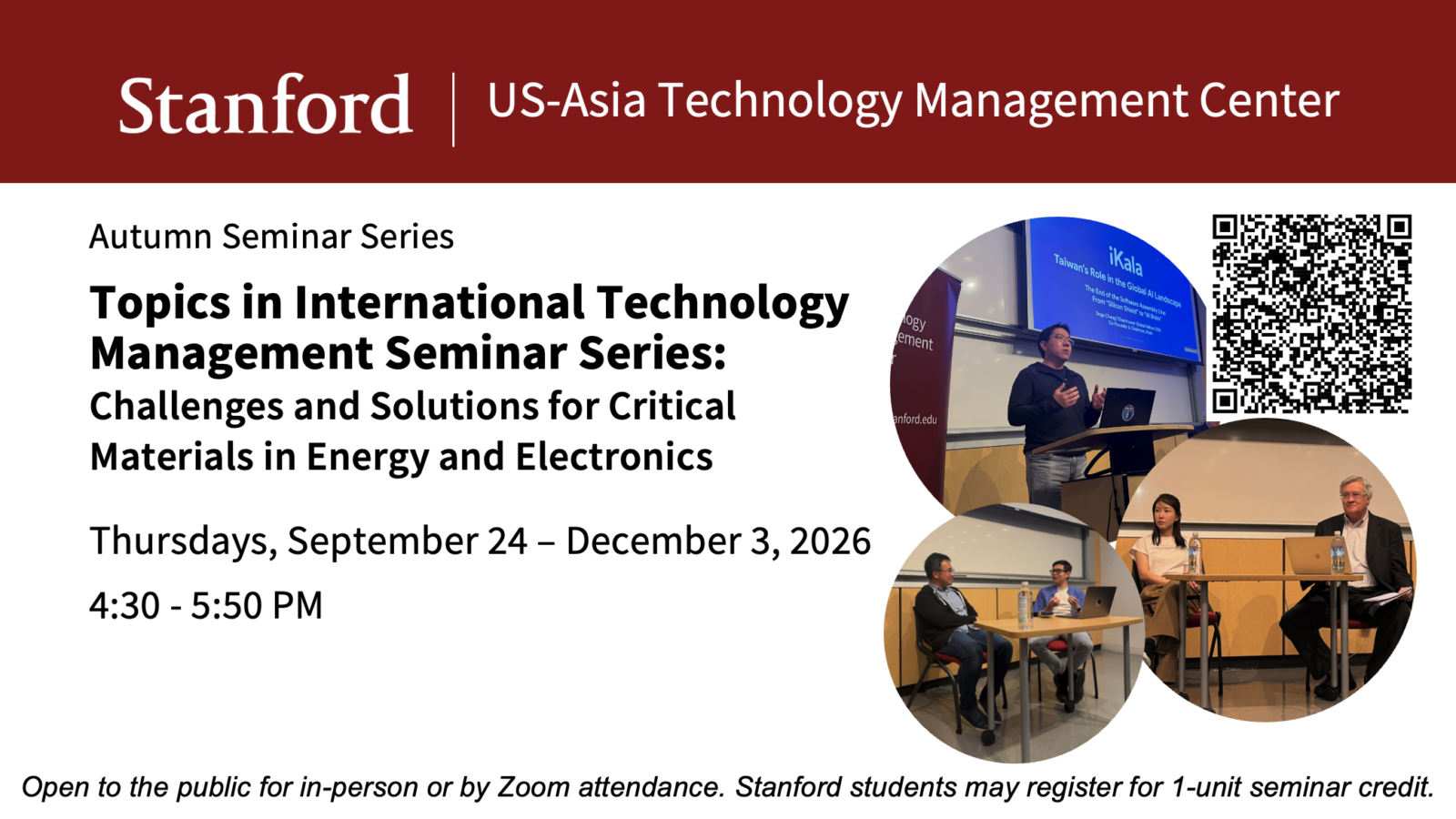
The Genesis Mission AI Project: From Materials Development to Autonomous Labs and Beyond
Thursday, Dec 3, 2026
04:30 pm - 05:50 pm
How can artificial intelligence accelerate the discovery and development of critical materials? This panel brings together Stanford and SLAC researchers involved in the new Genesis Mission AI Project to explore how AI can transform scientific research and address challenges in critical materials. Panelists will introduce their research and discuss opportunities for applying AI to materials discovery, energy storage, and other technologies essential to the future of energy and advanced manufacturing.
Details
Registration:
- To attend in-person, RSVP on Eventbrite TBA.
- To attend online, register on Zoom here.
Agenda:
- 4:30 pm – 5:50 pm Discussion and Audience Q&A
Venue:
- Stanford University, Bishop Auditorium, 518 Memorial Way, Stanford, CA 94305 [Google Map]
Parking options:
- Memorial Way, Stanford, CA 94305 [Google Map]
- Lasuen St. and Roth Way, Stanford, CA 94305 [Google Map]
- Please check parking signs carefully to ensure that permitted parking (A or C) and metered spaces are free after 4:00 pm. Paid parking is enforced around The Oval until 6:00 pm.
Speakers
Dr. Ahamed Irshad
Associate Scientist, SLAC-Stanford Battery Center, SLAC National Accelerator Laboratory
Ahamed Irshad is an electrochemist and battery scientist leveraging extensive research experience in non-aqueous and aqueous batteries and water electrolyzers toward achieving diverse goals, objectives, and milestones in sustainability. He has more than a decade of research experience in energy conversion and storage devices.
He has developed novel solid electrolyte cell designs using PEO and boron clusters and explored the utility of impedance spectroscopy and EQCM to understand the fundamental processes in batteries and electrocatalysis. He is also actively engaged in a DOE collaborative project with Caltech, UCLA, UCSB, UCSD, and SLAC.
Dr. Dimosthenis Sokaras
Senior Scientist, SLAC National Accelerator Laboratory and Director of the Chemistry and Catalysis Division, Stanford Synchrotron Radiation Lightsource
Dimosthenis Sokaras is a Senior Scientist at SLAC National Accelerator Laboratory and the Director of the Chemistry and Catalysis Division at the Stanford Synchrotron Radiation Lightsource (SSRL). His efforts focus on leveraging and expanding SSRL’s capabilities to address emerging research priorities of the U.S. Department of Energy, with emphasis on energy conversion, catalysis, and next-generation technologies for industrial and national competitiveness. His work centers on the development and application of novel X-ray tools -including high energy resolution, time-resolved, and operando techniques- that enable experimental studies under realistic working conditions. He also leads the Integrated Scientific Agentic AI for Catalysis (ISAAC), a DOE Basic Energy Sciences AI Pathfinder project developing agentic AI for scientific reasoning and discovery in catalysis.
Together with his team, he bridges synthesis, performance evaluation, and advanced diagnostics with high-accuracy theoretical calculations on DOE supercomputing platforms. This integrated approach enables the interpretation of complex spectral signatures and the identification of transient and reactive states that remain inaccessible to conventional methods. Their efforts deepen fundamental understanding and support the design of more effective materials for catalysis and energy conversion.
Dr. Sokaras plays a leading role in shaping SSRL’s strategic direction and strengthening its synergy with other SLAC programs and DOE national initiatives. Mentorship and team development are central to his role, and he actively builds cross-disciplinary teams that expand the facility’s scientific reach and long-term impact.
Dr. Johannes Voss
Staff Scientist, SLAC National Accelerator Laboratory
Johannes Voss is staff scientist at SLAC National Accelerator Laboratory. He leads the machine learning and electronic structure method efforts at the SUNCAT Center for Interface Science and Catalysis. The team develops machine learning models for the accurate and efficient prediction of catalytic reaction energies and materials properties. These developments include exchange-correlation functionals for computational surface science and efficient beyond density functional theory approaches. The team uses machine learning and first-principles methods to gain an understanding of energy and charge transfer and reaction mechanisms governing the performance of catalysts and battery materials.
Within the Ultrafast Catalysis FWP at SLAC, he leads the efforts of X-ray spectra simulations for understanding of ultrafast surface chemistry as observed using free-electron lasers.
